Tesla's $10.1 Billion "Project Crystal Sun" Could Bring a Massive Solar Plant to Fort Bend County
By Summer Lakes Admin · August 9, 2026 · Updated August 25, 2026 · 10 min read
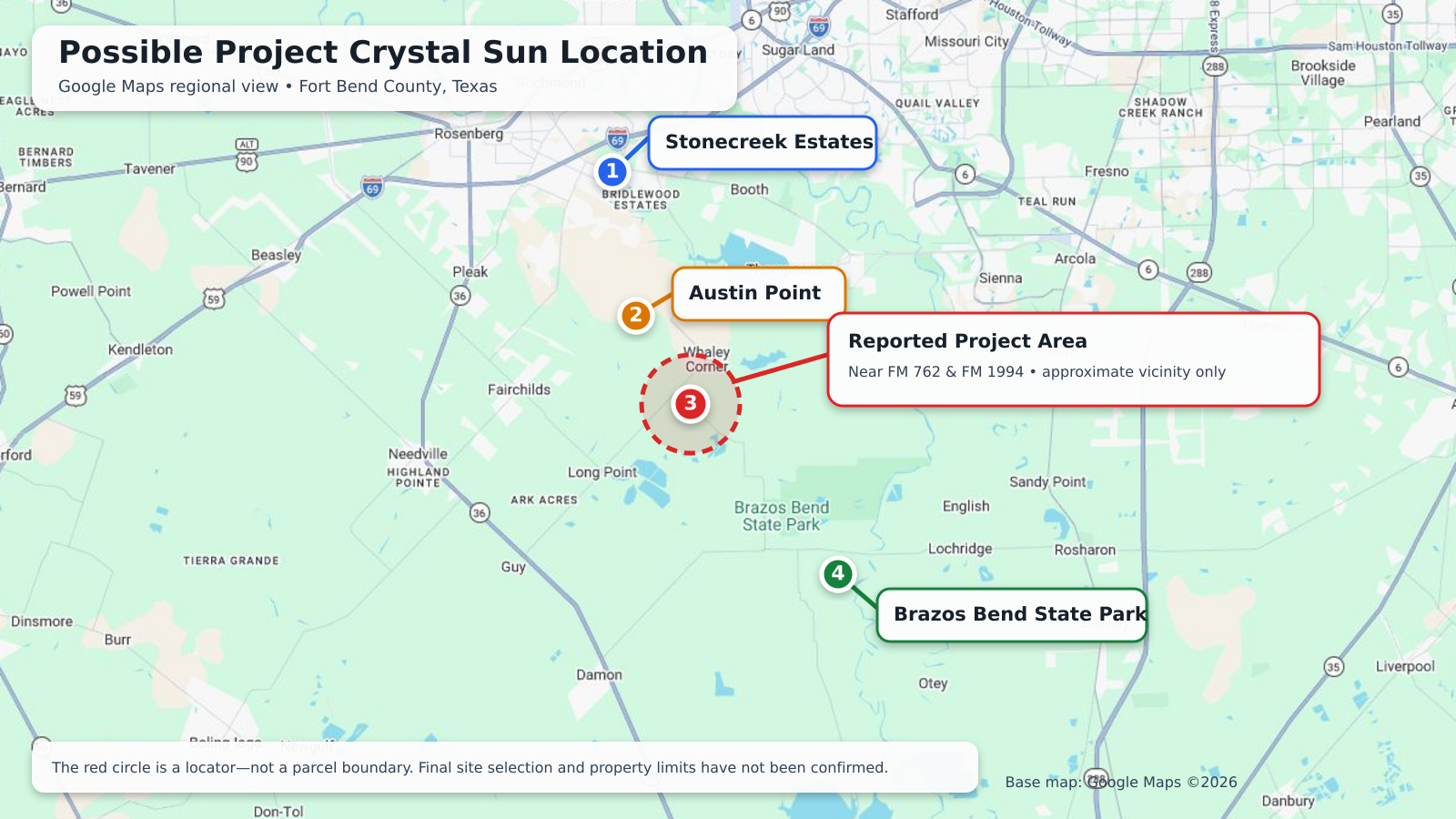
Fort Bend County may be in the running for one of the largest industrial investments in its history.
Tesla has filed an application describing a proposed $10.1 billion vertically integrated solar-cell and solar-module manufacturing facility on land near Richmond. The internal project name is Project Crystal Sun, which sounds a little like a superhero headquarters but is, in fact, a serious economic-development proposal involving advanced manufacturing, thousands of acres and a very large request for tax incentives.
If built as described, the plant could transform a mostly rural part of Fort Bend County into a major center for domestic solar manufacturing. Tesla estimates that the completed operation could ultimately support 9,712 permanent full-time jobs, in addition to roughly 1,147 jobs at the peak of construction.
Those are enormous numbers. They are also projections in an incentive application—not employees already being hired for a confirmed Fort Bend plant. Tesla says it is comparing the local site with at least one location outside Texas, and the company has not made a final commitment to build here.
That distinction matters. Fort Bend County is being considered. It has not yet won the project.
Where Would Project Crystal Sun Be Located?
The application identifies approximately 3,000 acres across five parcels within the boundaries of Lamar Consolidated Independent School District. Reporting based on the filing places the proposed site near FM 762 and FM 1994, south of the Richmond-Rosenberg area.
For Summer Lakes residents, this would not be a factory appearing next door. However, a project of this scale could still affect the broader Richmond and Rosenberg area through employment, housing demand, school-district finances, utility construction, commercial development and traffic on regional roads.
The proposed location also fits a larger pattern. Fort Bend County's southern and southwestern areas still contain large tracts of developable land, while nearby highways and the Houston region provide access to workers, suppliers, freight routes and the Port of Houston.
What Would the Factory Actually Make?
Project Crystal Sun is described as much more than a building where imported parts would be snapped together into finished panels.
Tesla proposes a vertically integrated manufacturing operation. In normal-human language, that means the company wants to perform several major stages of solar production at the same campus rather than relying entirely on outside suppliers.
The application describes equipment and facilities that could support ingot manufacturing, wafer production, photovoltaic cell manufacturing, coating processes, metallization and printing lines, cell testing and quality control, solar-module assembly, automated material handling, cleanroom infrastructure, chemical and raw-material storage, and warehousing and supporting utilities.
Solar cells are the components that convert sunlight into electricity. Those cells are then assembled into solar modules—the finished panels people recognize on rooftops and in utility-scale solar farms.
The proposed Fort Bend operation would make products for utility-scale, commercial and distributed solar installations. In other words, the output could be used for large solar farms, business installations and smaller systems located closer to where electricity is consumed.
How Large Is the Proposed Investment?
Tesla's stated capital investment totals approximately $10.1 billion: $1.5 billion in real property, including buildings and site improvements, and $8.6 billion in equipment and other personal property.
That equipment-heavy split makes sense for an advanced manufacturing plant. Cleanrooms, highly automated production lines, testing systems and specialized solar-cell machinery can cost far more than the walls surrounding them.
The scale also helps explain why Tesla is pursuing incentives before selecting a final site. A difference in property-tax treatment can materially change the long-term cost of operating billions of dollars' worth of taxable equipment.
What Tax Incentive Is Tesla Requesting?
Tesla applied through Texas' Jobs, Energy, Technology and Innovation Act, commonly called the JETI Act. The program allows qualifying large projects to negotiate a temporary limitation on the taxable value of certain property for school-district maintenance-and-operations taxes.
Tesla is seeking a 10-year property-tax limitation connected to the Lamar CISD site.
This does not mean the company would simply pay no taxes. The exact value of any limitation, the property covered, required job and wage commitments, district payments and enforcement provisions would depend on a final agreement and state approval.
For residents, the right question is not merely, "Is Tesla receiving an incentive?" The better questions are: What is the total value of the incentive? What tax revenue would the district and other local entities receive with and without it? How many jobs would be contractually required? What wages and benefits would qualify? What happens if investment or job targets are missed? What infrastructure costs would fall on taxpayers? What protections would be included for Lamar CISD?
Tesla's economic analysis reportedly estimates more than $6.4 billion in local and state tax revenue over a 38-year period if the project proceeds. That is a company-backed forecast and should be evaluated alongside the final incentive terms, independent public analysis and the costs of serving a project of this size.
How Many Jobs Could It Create?
The application projects approximately 9,712 permanent full-time jobs at full operation and 1,147 peak construction jobs during the building period. It also estimates annual payroll could reach roughly $1.3 billion by 2033.
If those numbers materialized, the economic effect would reach far beyond the plant gates. A manufacturing campus needs engineers, technicians, equipment-maintenance teams, cleanroom operators, quality-control specialists, logistics workers, managers, safety staff and administrative employees. It also creates demand for construction firms, suppliers, restaurants, retailers, housing and professional services.
But residents should resist treating the 9,712 figure as a guaranteed opening-day head count. Major industrial projects normally hire in phases, and employment forecasts can change as plant designs, automation levels and production targets are refined.
The most useful numbers will eventually be the job commitments written into an enforceable agreement—not the largest number printed in an early projection.
What Is the Proposed Timeline?
The filing outlines an aggressive schedule: construction beginning as early as 2026, major development continuing through 2028, and commercial operations targeted for the first quarter of 2029.
That timetable should be read as a target. Before a campus of this size can begin operating, the project would need to complete incentive negotiations, site acquisition or control, design, environmental and development reviews, utility planning, permits, construction and equipment installation.
Tesla is known for ambitious manufacturing schedules. Sometimes it moves remarkably fast; sometimes the calendar and reality decide they need couples counseling. Until contracts, permits and visible site work appear, 2029 remains a proposed opening date.
Why Is Tesla Expanding Solar Manufacturing?
Tesla is best known for electric vehicles, but energy generation and storage have always been part of its stated mission. Its energy business includes solar products, residential Powerwall batteries and utility-scale Megapack storage systems.
In early 2026, Tesla leaders began recruiting engineers and scientists around a goal of building 100 gigawatts of annual solar-manufacturing capacity in the United States. Reuters reported that company job postings described an objective of reaching that scale before the end of 2028.
That goal is extraordinarily ambitious. For perspective, Reuters reported that the United States then had roughly 65 gigawatts of solar-module manufacturing capacity but only about 3.2 gigawatts of solar-cell capacity. Modules are the finished panels; cells are the technologically demanding components inside them. Domestic module factories can still depend on imported cells.
A vertically integrated Texas facility could help Tesla reduce its reliance on overseas suppliers and manufacture more of the solar supply chain domestically.
Tesla has also been expanding its energy footprint west of Houston. The company is developing Megapack manufacturing operations in the Brookshire area and advertising solar-manufacturing positions there. Project Crystal Sun appears to be a separate and much larger site proposal within Lamar CISD, although the Houston region's industrial workforce and logistics network could benefit both operations.
What Could This Mean for Richmond, Rosenberg and Summer Lakes?
The most immediate effect would be attention. A $10.1 billion proposal places Fort Bend County on the national advanced-manufacturing map before the first shovel reaches the ground.
If the plant is confirmed and developed, likely regional effects could include:
More demand for housing. Thousands of construction and permanent workers would need places to live. Richmond, Rosenberg and nearby communities could see additional demand for both homes and apartments. That does not automatically mean every home value would soar. Interest rates, new-home construction, commute patterns, property taxes and the number of workers relocating from outside the area would all influence the housing market. Still, a major employment center usually becomes an important part of long-term real-estate demand. Track local trends on our Market Report page.
More business growth. Restaurants, childcare providers, medical offices, retailers, contractors and business-to-business suppliers tend to follow large concentrations of workers. Existing Richmond and Rosenberg businesses could gain new customers, while developers may accelerate commercial projects along the roads connecting residential areas to the plant.
More pressure on roads. Construction traffic alone could be substantial. Once operating, multiple shifts could place additional demand on FM 762, FM 1994 and the broader network connecting the site with I-69, SH 99 and other regional routes. Residents should watch for traffic-impact analyses, roadway-improvement agreements, truck-route plans and intersection upgrades. A plant can promise thousands of jobs; it cannot magically create thousands of extra lanes by positive thinking.
New demands on utilities and public services. Solar-cell manufacturing is an industrial process requiring substantial electricity, water, wastewater capacity and carefully managed chemicals. Fire protection, emergency response, drainage and floodplain planning will be important parts of the public review. The proposed site's environmental permits, water demand, wastewater treatment, drainage design and chemical-handling plans should receive close attention as technical documents become available.
Potential effects on Lamar CISD. The site lies within Lamar CISD, one of the state's fastest-growing districts. A large industrial tax base can be valuable over time, but a temporary tax limitation changes when and how much revenue is recognized. The district will need to weigh the long-term taxable value and economic benefits against the incentive's cost and any additional demands created by housing growth. Residents deserve a clear explanation of the agreement before approval, including required payments, performance standards and protections if the project is delayed or reduced. Follow School Updates as more details become available.
Is Project Crystal Sun Definitely Coming?
No—not yet.
Tesla's filing says the company is evaluating the Fort Bend property against at least one out-of-state alternative. The company argues that JETI incentives would help make the Texas site economically competitive.
That is common in large economic-development projects. Companies compare land, labor, infrastructure, logistics, utility capacity and incentive packages before committing billions of dollars.
For now, the most accurate description is: Tesla has proposed and is evaluating a $10.1 billion solar manufacturing campus in Fort Bend County. The company has filed for incentives, but it has not publicly made a final site commitment.
Calling it "the new Tesla plant" is tempting, but it skips several important chapters.
What Should Residents Watch Next?
The story becomes more concrete when one or more of these milestones occur: Lamar CISD publicly considers or approves a JETI agreement; the Texas Comptroller completes its review of the application; Tesla confirms the Fort Bend location in a corporate announcement; land transactions or long-term site-control agreements are recorded; environmental, utility, development and construction permits are filed; road and drainage improvement plans become public; Tesla begins hiring specifically for the Fort Bend campus; or site preparation or construction begins on the identified parcels.
Until then, residents should be interested—and cautiously optimistic—without treating every projected number as settled fact.
The Bottom Line
Project Crystal Sun could be a defining development for Fort Bend County. A $10.1 billion vertically integrated solar plant, nearly 3,000 acres and a projected 9,712 permanent jobs would reshape the local economy and the rural landscape south of Richmond and Rosenberg.
It could also bring genuine challenges: traffic, infrastructure costs, water and power demand, environmental oversight, school-district growth and a complicated incentive agreement involving public revenue.
That does not make the proposal good or bad by default. It makes it big enough to deserve careful, fact-based attention.
The exciting headline is that Tesla is considering Fort Bend County for one of America's most ambitious solar-manufacturing projects. The honest headline includes one additional word: could.
This site will continue following the filings, public meetings, permits and construction milestones as Project Crystal Sun moves from proposal toward a final decision.
Sources